googleb1fd7cd7ef71feda.html
Εμφάνιση αναρτήσεων με ετικέτα eclipse. Εμφάνιση όλων των αναρτήσεων

Πέμπτη 3 Απριλίου 2025

Astronomy Picture Of The Day: A Double Sunrise from a Partial Eclipse

#NASA, #Space, #astronomy, #διάστημα, #sunrise, #partially_eclipsed #theSun

 
Explanation: Can the Sun appear to rise twice at the same time? This was just the case a few days ago from Les Escoumins, Quebec, Canada as our Solar System's bright central orb rose just as it was being partially eclipsed by the Moon. The featured video shows this unusual double-sunrise in real time and being reflected by the St. Lawrence River. Soon after the initial two spots of light appear over distant clouds, what appears to be bright horns become visible -- which are really just parts of the Sun not being eclipsed. Soon, the entire eclipsed Sun is visible above the horizon. In all, this broken sunrise took less than two minutes during a partial eclipse that lasted many times longer. Although the Moon circles the Earth once a month (moon-th), it does not always eclipse the Sun because its tilted orbit usually takes it above or below.

https://apod.nasa.gov/apod/ap250401.html

Δευτέρα 14 Οκτωβρίου 2024

Astronomy Picture Of The Day: Annular Eclipse over Patagonia


#Moon, #solareclipse , #NASA , #Space ,#astronomy
 

Explanation: Can you find the Sun? OK, but can you explain why there’s a big dark spot in the center? The spot is the Moon, and the impressive alignment shown, where the Moon lines up inside the Sun, is called an annular solar eclipse. Such an eclipse occurred just last week and was visible from a thin swath mostly in Earth's southern hemisphere. The featured image was captured from Patagonia, Chile. When the Moon is significantly closer to the Earth and it aligns with the Sun, a total solar eclipse is then visible from parts of the Earth. Annular eclipses are slightly more common than total eclipses, but as the Moon moves slowly away from the Earth, before a billion more years, the Moon's orbit will no longer bring it close enough for a total solar eclipse to be seen from anywhere on Earth.

https://apod.nasa.gov/apod/ap241008.html

Κυριακή 13 Οκτωβρίου 2024

Astronomy Picture Of The Day: Ring of Fire over Easter Island


#Moon, #solareclipse , #NASA , #Space ,#astronomy
 

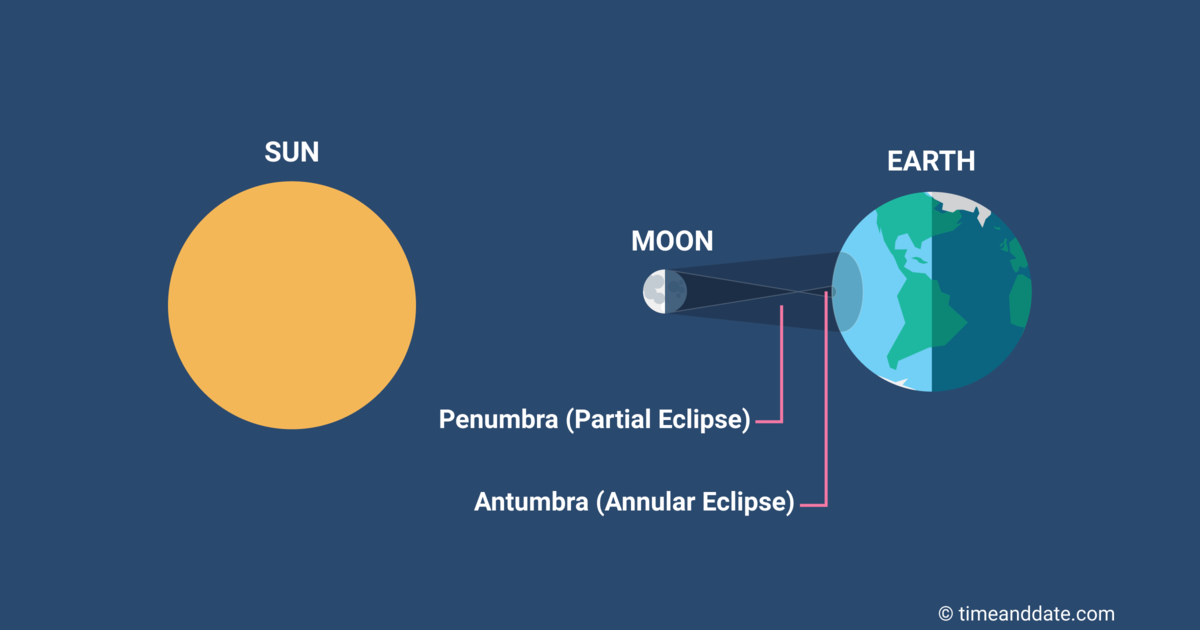
The second solar eclipse of 2024 began in the Pacific. On October 2nd the Moon's shadow swept from west to east, with an annular eclipse visible along a narrow antumbral shadow path tracking mostly over ocean, making its only major landfall near the southern tip of South America, and then ending in the southern Atlantic. The dramatic total annular eclipse phase is known to some as a ring of fire. Also tracking across islands in the southern Pacific, the Moon's antumbral shadow grazed Easter Island allowing denizens to follow all phases of the annular eclipse. Framed by palm tree leaves this clear island view is a stack of two images, one taken with and one taken without a solar filter near the moment of the maximum annular phase. The New Moon's silhouette appears just off center, though still engulfed by the bright disk of the active Sun.

https://apod.nasa.gov/apod/ap241011.html

Σάββατο 21 Οκτωβρίου 2023

Astronomy Picture of the Day: A Sunrise at Sunset Point


#moon, #Sun, #space, #eclipse 

Explanation: This timelapse series captured on October 14 is set against the sunrise view from Sunset Point, Bryce Canyon, planet Earth. Of course on that date the New Moon caught up with the Sun in the canyon's morning skies. Local temperatures fell as the Moon's shadow swept across the high altitude scene and the brilliant morning sunlight became a more subdued yellow hue cast over the reddish rocky landscape. In the timelapse series, images were taken at 2 minute intervals. The camera and solar filter were fixed to a tripod to follow the phases of the annular solar eclipse.

https://apod.nasa.gov/apod/ap231019.html

Παρασκευή 13 Οκτωβρίου 2023

Astronomy Picture of the Day: A Distorted Sunrise Eclipse


#eclipse,#space,

Explanation: Yes, but have you ever seen a sunrise like this? Here, after initial cloudiness, the Sun appeared to rise in two pieces and during a partial eclipse in 2019, causing the photographer to describe it as the most stunning sunrise of his life. The dark circle near the top of the atmospherically-reddened Sun is the Moon -- but so is the dark peak just below it. This is because along the way, the Earth's atmosphere had a layer of unusually warm air over the sea which acted like a gigantic lens and created a second image. For a normal sunrise or sunset, this rare phenomenon of atmospheric optics is known as the Etruscan vase effect. The featured picture was captured in December 2019 from Al Wakrah, Qatar. Some observers in a narrow band of Earth to the east were able to see a full annular solar eclipse -- where the Moon appears completely surrounded by the background Sun in a ring of fire. The next solar eclipse, also an annular eclipse for well-placed observers, will occur this coming Saturday.

https://apod.nasa.gov/apod/ap231009.html

Κυριακή 1 Οκτωβρίου 2023

Astronomy Picture of the Day: Moon Mountains Magnified during Ring of Fire Eclipse

#Moon, #Space, #eclipse 

Explanation: What are those dark streaks in this composite image of a solar eclipse? They are reversed shadows of mountains at the edge of the Moon. The center image, captured from Xiamen, China, has the Moon's center directly in front of the Sun's center. The Moon, though, was too far from the Earth to completely block the entire Sun. Light that streamed around the edges of the Moon is called a ring of fire. Images at each end of the sequence show sunlight that streamed through lunar valleys. As the Moon moved further in front of the Sun, left to right, only the higher peaks on the Moon's perimeter could block sunlight. Therefore, the dark streaks are projected, distorted, reversed, and magnified shadows of mountains at the Moon's edge. Bright areas are called Baily's Beads. Only people in a narrow swath across Earth's Eastern Hemisphere were able to view this full annular solar eclipse in 2020. Next month, though, a narrow swath crossing both North and South America will be exposed to the next annular solar eclipse. And next April, a total solar eclipse will be visible across North America.

https://apod.nasa.gov/apod/ap230917.html
Παρασκευή 29 Σεπτεμβρίου 2023

Astronomy Picture of the Day:A Ring of Fire Sunrise Solar Eclipse

#Earth, #Eclipse, #Sun, #Moon

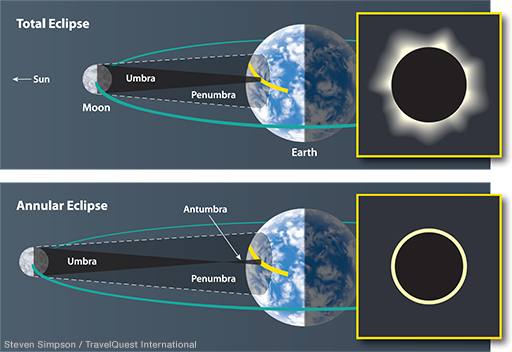
Explanation: What's rising above the horizon behind those clouds? It's the Sun. Most sunrises don't look like this, though, because most sunrises don't include the Moon. In the early morning of 2013 May 10, however, from Western Australia, the Moon was between the Earth and the rising Sun. At times, it would be hard for the uninformed to understand what was happening. In an annular eclipse, the Moon is too far from the Earth to block the entire Sun, and at most leaves a ring of fire where sunlight pours out around every edge of the Moon. The featured time-lapse video also recorded the eclipse through the high refraction of the Earth's atmosphere just above the horizon, making the unusual rising Sun and Moon appear also flattened. As the video continues, the Sun continues to rise, while the Sun and Moon begin to separate. The next annular solar eclipse will occur in less than three weeks. On Saturday, October 14, a ring of fire will be visible through clear skies from a thin swath crossing both North and South America.

https://apod.nasa.gov/apod/ap230924.html