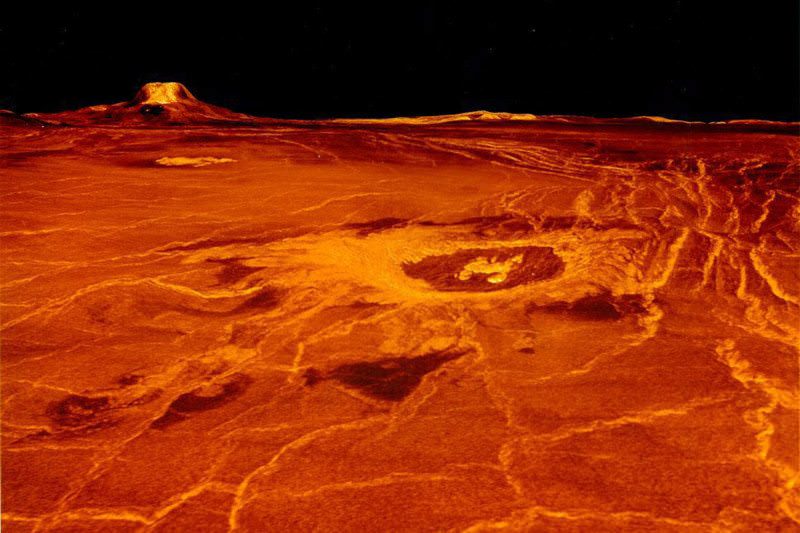
Nicknamed Earth’s evil twin, Venus seems like everything our planet is not: scorching hot, dried out and covered in toxic clouds.
But a mere one or two billion years ago, these two wayward siblings might have been more alike. New computer simulations suggest that early Venus might have looked a lot like our home planet – and it might even have been habitable.
“It’s one of the big mysteries about Venus. How did it get so different from Earth when it seems likely to have started so similarly?” says David Grinspoon at the Planetary Science Institute in Tucson, Arizona. “The question becomes richer when you consider astrobiology, the possibility that Venus and Earth were very similar during the time of the origin of life on Earth.”
Grinspoon and his colleagues aren’t the first to imagine that Venus was once hospitable. It’s similar to Earth in size and density, and the fact that the two planets formed so close together suggests that they’re made of the same bulk materials. Venus also has an unusually high ratio of deuterium to hydrogen atoms, a sign that it once housed a substantial amount of water, mysteriously lost over time.
Venus, but snowy
To simulate early Venus, the researchers turned to a model of environmental conditions often used to study climate change here on Earth. They created four versions for Venus, each varying slightly in details such as the amount of energy the planet received from the sun, or the length of a Venusian day. Where information was scant about Venus’s climate, the team filled in educated guesses. They also added a shallow ocean, 10 per cent the volume of Earth’s ocean, covering about 60 per cent of the planet’s surface.
Looking at how each version might have evolved over time, the researchers say they were encouraged to believe that the planet might have looked much like an early Earth, and remained habitable for a substantial portion of its lifetime. The most promising of the four Venuses enjoyed moderate temperatures, thick cloud cover and even the occasional light snowfall.
Could life have emerged on this early Venus? If it did, it’s certainly no more, thanks to the oceans later boiling away and volcanoes drastically reshaping the landscape around 715 million years ago. But the team is not ruling it out.
“There’s great uncertainties in understanding Earth, not only its climate history but the history of how life began,” says Michael Way at the NASA Goddard Institute for Space Studies in New York City. If it began in oceans on Earth – a theory we’ve yet to confirm – the same could be true on a waterlogged Venus. “There’s no reason that life on this world would not have existed in these oceans. But that’s about all you can say.”
Read More:
https://www.newscientist.com/article/2100191-venus-could-have-been-habitable-while-life-evolved-on-earth/


Δεν υπάρχουν σχόλια:
Δημοσίευση σχολίου